Preprint · arXiv:2607.12892
Offline · Training-free · Label-free
UR-VC: Unsupervised Robotic Value Correction for Time-Derived Progress Proxies
UR-VC uses recurring visual states across demonstrations to correct normalized-time progress labels before they become supervision.
The University of Hong Kong
01 / Examples
UR-VC progress correction in complete cloth flatten-and-fold episodes
Example 2
In these real bimanual cloth flatten-and-fold episodes, the garment slips in the grasp, reintroducing wrinkles and moving the task state backward. The corrected progress estimate from UR-VC falls with this visible regression, while normalized time continues to increase.

Interactive examples could not be loaded. The paper and static results remain available below.
02 / Abstract
Abstract
Modern robot learning systems increasingly rely on dense progress or value signals to evaluate intermediate states, guide policy learning, and detect task completion, making the quality of these signals critical. Since such dense labels are rarely available at scale, normalized time within a demonstration is often used as a scalable substitute: later frames are treated as higher progress. However, this time-derived label is only a noisy proxy for physical task progress. In contact-rich manipulation, a robot may make progress and then lose it through slips, failed grasps, or partial undoing, while the time-derived label continues to increase monotonically.
We introduce Unsupervised Robotic Value Correction (UR-VC), an offline, training-free method for correcting time-derived progress labels. UR-VC exploits a simple regularity in demonstration data: similar states often recur across different episodes, but at different timestamps. Instead of trusting the timestamp from a single trajectory, UR-VC retrieves similar states from other episodes and aggregates their time-derived labels to obtain a corrected progress estimate. UR-VC requires no manual progress labels, reward annotations, or additional value model.
We evaluate UR-VC on real bimanual cloth flatten-and-fold data, a long-horizon deformable-object manipulation task with visible intermediate progress. The corrected labels capture local regressions and non-uniform progress that normalized time cannot represent, while preserving the overall task trend. We further use the corrected signal to construct advantage labels for VLA training, following recent advantage-conditioned policy learning. UR-VC shows a positive trend in real-robot task success under matched data, model, and training settings.
03 / Method
Method overview
UR-VC replaces a single trajectory’s timestamp with evidence aggregated from the same visual state across independent demonstrations.
-
01
Time is a proxy
Start from normalized episode time, a scalable label that assumes monotone progress.
gt = t / Te
-
02
Match across demonstrations
Retrieve semantically similar frames from other episodes, with at most one representative from each trajectory.
j*i,e = arg max sim(fi, fj)
-
03
Correct the supervision
Average matched timestamps with equal episode weight, then derive advantage supervision from the corrected signal.
ĝi = 1 / |Mi| Σe∈Mᵢ gj*(e)
ri = ĝi+H − ĝi
04 / Evidence
Experimental evidence
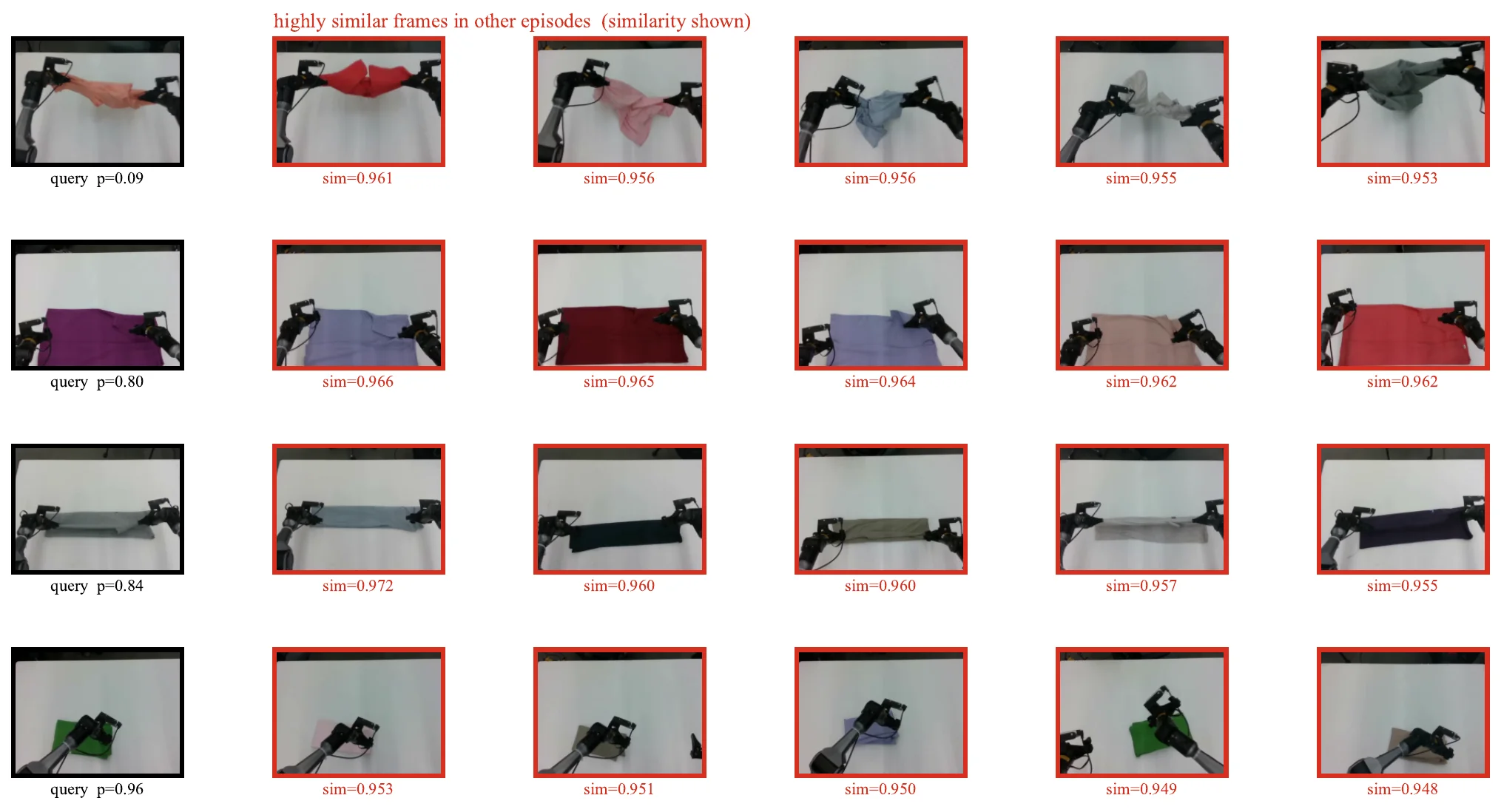
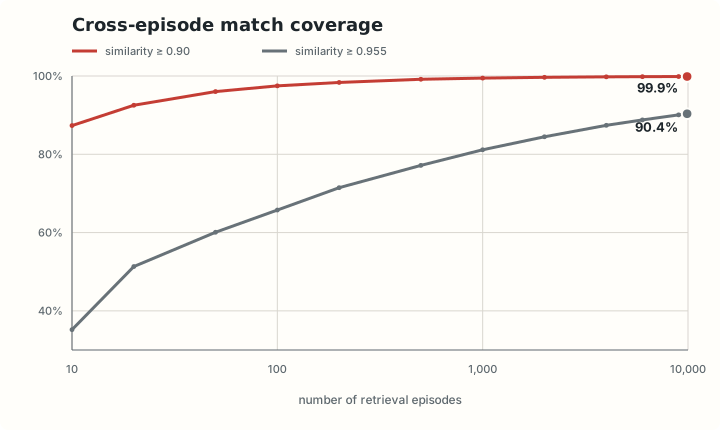
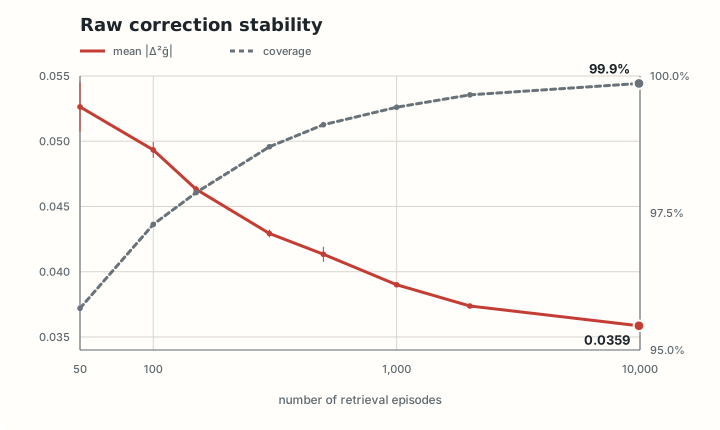
| Evaluation | Average success | Protocol |
|---|---|---|
| Real-robot success | 72.8% → 78.9% | UR-VC converts corrected progress into advantage labels for advantage-conditioned VLA training. Across six table conditions—a bare table and five tablecloth backgrounds, with 30 trials each—success improves in 5 of 6 conditions. The backbone, training data, optimization schedule, and policy objective remain unchanged. |
05 / Limitations
Limitations
Visual ambiguity
UR-VC assumes that visually similar observations indicate similar task progress. This assumption is shared with progress estimator and value models: when visually similar states occur at different task stages or after different action histories, their latent progress can be ambiguous. Episode-balanced averaging reduces trajectory-specific timing noise, but it cannot correct systematic retrieval errors.
Evaluation scope
Our downstream evaluation focuses on one representative use case: using UR-VC-derived supervision for advantage-conditioned VLA training in real bimanual cloth manipulation. Under matched experimental settings, the corrected labels lead to higher average success, suggesting their practical utility as a drop-in supervision signal. Future work may further examine the method across broader task families, training scales, and hyperparameter settings.
06 / Citation
Citation
@misc{zhao2026urvc,
  title         = {UR-VC: Unsupervised Robotic Value Correction for Time-Derived Progress Proxies},
  author        = {Zhao, Lirui and Shi, Modi and Chen, Li and Liu, Qi and Luo, Ping and Li, Hongyang},
  year          = {2026},
  eprint        = {2607.12892},
  archivePrefix = {arXiv},
  primaryClass  = {cs.RO},
  url           = {https://arxiv.org/abs/2607.12892}
}